Firefighting Foam Backflow Disasters: Why Fire Line & Chemical Cross-Connections Require RPZ Assemblies
Published on October 14, 2026 | 1,350 Words | Updated November 21, 2026 | By Backflow Compliance Technical Team
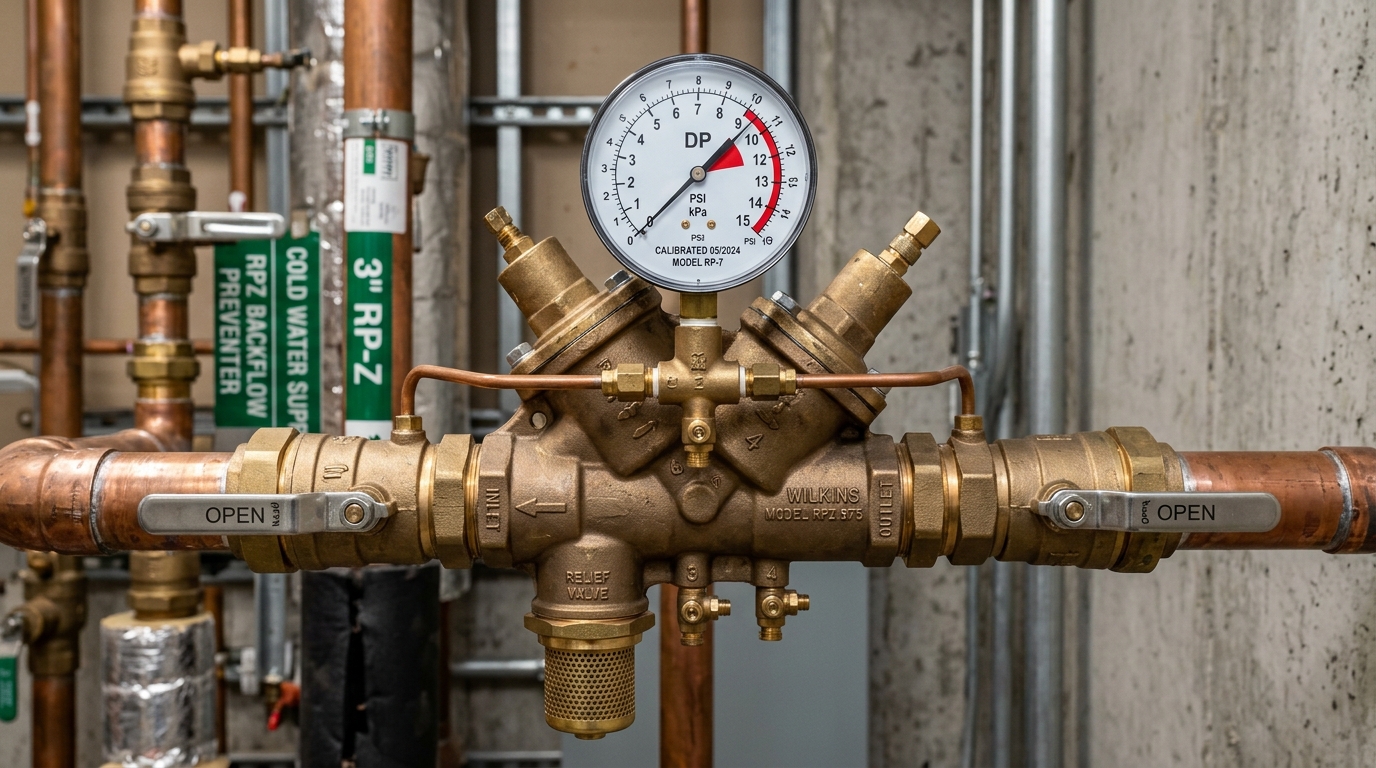
When a fire sprinkler or suppression line connects to municipal drinking water, chemical additives, foam concentrates, or antifreeze glycol legally classify the line as Severe Hazard under CSA B64.10—requiring a Reduced Pressure Principle (RPZ/RPDA) backflow preventer tested annually by a registered OWWA specialist.
In September 2024, tens of thousands of residents in Grand Prairie, Texas, received an urgent municipal emergency alert: DO NOT USE TAP WATER FOR ANY REASON. Residents were prohibited from drinking, cooking, washing dishes, or showering, while schools closed classes and emergency bottled water lines wrapped around community arenas. The trigger was not a water treatment plant malfunction—it was an industrial firefighting foam backflow event that pushed suppression chemicals backward into the public drinking water main.
1. Anatomy of the Contamination Event: How Foam Entered Potable Mains
During a major industrial warehouse fire on Avenue S, high-pressure suppression operations injected specialized firefighting foam into fire suppression piping. When downstream pressure generated by mobile fire apparatus and booster pumps exceeded the incoming municipal main pressure—combined with a compromised isolation boundary upstream of a working preventer—high-velocity chemical foam reversed course into the municipal distribution grid.
Even though municipal officials noted the modern foam concentrate was biodegradable and PFAS-free, laboratory water quality screening showed compromised tap water across a wide zone north of Interstate 20. Unlike bacterial contamination, boiling tap water could not remove chemical surfactants, forcing a 48-hour strict "do not use" ban, massive hydrant flushing, storage tower drainage, and post-flush building plumbing purges across thousands of private properties.
2. Fire Sprinkler Backflow Comparison Table (Ontario CSA B64.10 Rules)
Ontario commercial plazas, warehouses, hospitals, and high-rise condominiums rely on four distinct backflow assembly configurations depending on sprinkler additives and bypass metering:
| Assembly Type | CSA B64.10 Hazard Level | Typical Sizes | Permitted Ontario Applications |
|---|---|---|---|
| DCVA (Double Check Valve) | Low to Moderate | 2.5" – 10" | Unmetered wet-pipe Class 1/2 fire sprinkler risers with zero chemical or antifreeze additives. |
| DCDA (Double Check Detector) | Low to Moderate + Flow Detection | 3" – 10" | Dedicated municipal fire lines requiring an auxiliary 5/8" bypass meter to detect unauthorized water use or underground leaks. |
| RPZ (Reduced Pressure Zone) | Severe / High Hazard | 3/4" – 10" | Parking garage antifreeze (glycol) loops, foam proportioning systems, chemical storage warehouses, and non-potable cistern tie-ins. |
| RPDA (Reduced Pressure Detector) | Severe + Bypass Meter | 3" – 10" | Primary premise isolation on industrial fire mains feeding antifreeze loops or siamese chemical injection lines. |
3. Dual Ontario Oversight: NFPA 25 + Municipal Water Bylaws
Property owners in the Greater Toronto Area frequently get caught off-guard because fire line backflow devices fall under two separate regulatory authorities simultaneously:
- Ontario Fire Code & NFPA 25: Mandates annual inspection and 5-year internal valve inspections of fire sprinkler risers. When a fire sprinkler inspector notes an overdue municipal test tag on your 4-inch or 6-inch riser, they flag a Fire Code deficiency on your annual safety report.
- Municipal Water By-laws (Toronto Ch. 851, Peel 10-2017, York 2021-44, Hamilton 10-103): Require that both main assembly checks and the 5/8-inch bypass assembly on DCDA/RPDA units be tested every 12 months by a registered OWWA specialist using NIST-calibrated differential pressure gauges, with reports electronically filed directly into city portals.
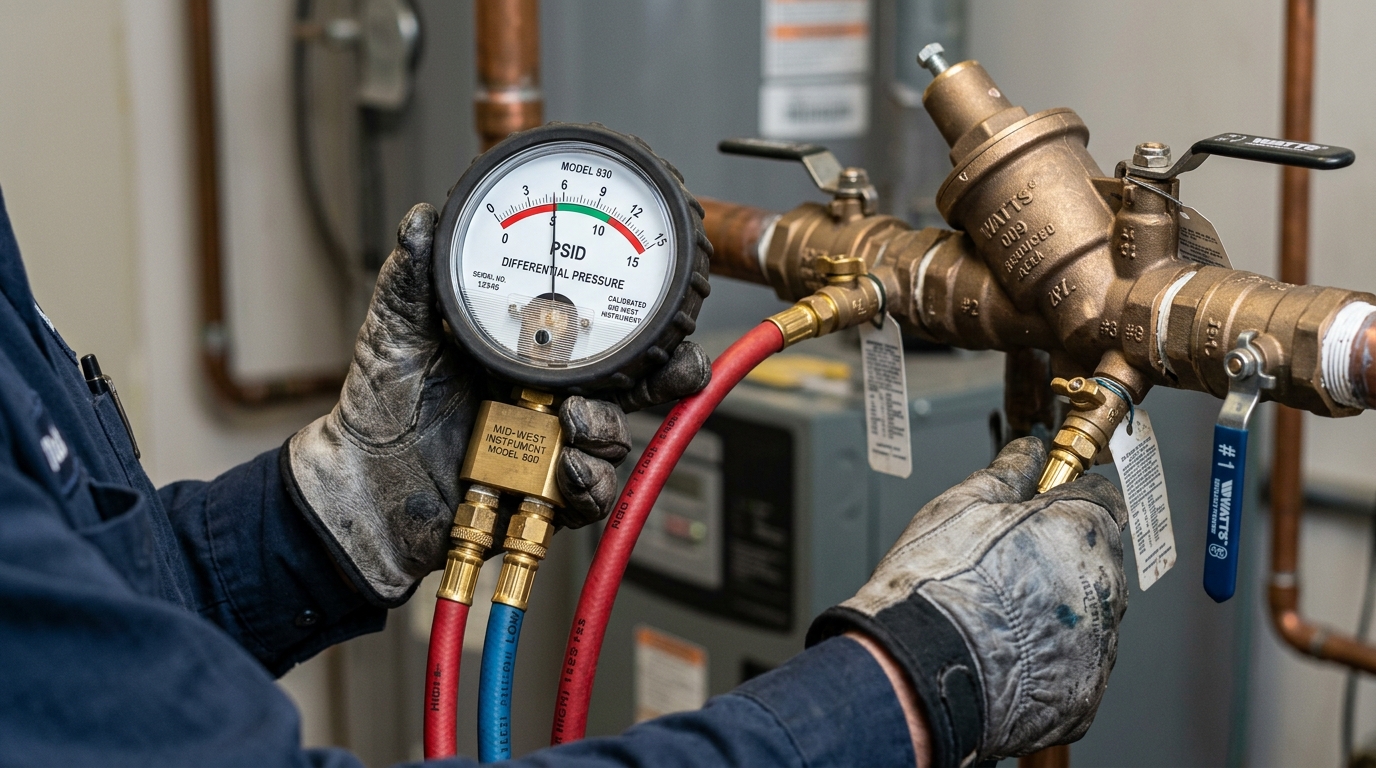
4. Zero-False-Alarm Fire Line Testing Protocol & Repair Windows
Testing large-bore fire sprinkler backflow preventers requires isolating Outside Screw and Yoke (OS&Y) gate valves or supervised butterfly valves fitted with electronic tamper switches. Simply spinning an OS&Y handwheel without proper coordination sends an immediate supervisory trouble alarm to your central station—or worse, dispatches the local fire department.
Our certified fire line backflow testing crews follow a strict 5-point field protocol:
- Coordinate dedicated maintenance windows with your building superintendent and fire safety plan contact.
- Place monitoring panels on verified central-station Test Mode with documented passcodes and call-back windows.
- Bleed air, flush test cocks, and record exact PSI holding differentials across Check #1, Check #2, differential relief port, and bypass assembly.
- When checks fail due to scale or fouled clapper rubbers, complete inline OEM rebuilds using stocked Watts (709/757/957), Zurn Wilkins (350/375/475), and Ames/Colt kits before leaving site.
- Restore OS&Y valves fully open, verify central-station supervisory status clears normally, affix the dated municipal tag, and submit digital reports immediately so shut-off warnings are closed out.
5. Property Manager Action Checklist Before Municipal Inspections
To protect your building, tenant insurance coverage, and local drinking water grid against back-pressure chemical incidents, verify three essentials this quarter: confirm all glycol or dry-pipe antifreeze loops are isolated by an RPZ/RPDA rather than a legacy DCVA, verify your 5/8-inch bypass meter backflow is tagged separately on annual reports, and book annual 5-year cross-connection surveys alongside annual device certification to lock in preferred multi-device portfolio rates.
Frequently Asked Questions
1. Why can a standard fire sprinkler company not submit my municipal backflow test report?
In Ontario, fire protection contractors perform NFPA 25 sprinkler flow tests, but municipal water authorities (such as Toronto Water, Peel Region, York Region, and Hamilton) legally require backflow test certificates to be signed and uploaded by an OWWA-certified Cross-Connection Control Specialist licensed as a Master/306A Plumber using an annually NIST-calibrated differential gauge.
2. Do wet-pipe fire sprinkler systems without glycol need an RPZ or a DCVA?
Standard wet-pipe sprinkler systems fed directly from municipal potable water with no chemical additives are classified as Low/Moderate Hazard under CSA B64.10 and typically require a Double Check Valve Assembly (DCVA) or Double Check Detector Assembly (DCDA). Any system with antifreeze, foam, or booster pumps connected to auxiliary tanks requires an RPZ/RPDA.
3. Will testing a 4-inch or 6-inch fire line backflow preventer set off the building fire alarm?
Only if shut-off supervisory tamper switches are closed without placing the central station panel into Test Mode first. Our technicians coordinate directly with your superintendent and fire monitoring station before shutting OS&Y or butterfly valves and verify full signal restoration afterward.
4. Can a failed large-bore fire line DCVA or RPZ be repaired without cutting pipe?
Yes. Over 80% of 2.5-inch to 10-inch valve failures are caused by debris under the check clapper or hardened elastomer seals. Inline swing-check and modular cartridge kits from Watts, Zurn Wilkins, and Ames allow complete rebuilds in the mechanical room within a single scheduled shutdown window.
Need Certified Fire Line Backflow Testing or Valve Rebuilds?
We test and rebuild 2.5" to 10" Watts, Zurn Wilkins, Ames, and Febco fire sprinkler backflow assemblies across Toronto, Peel, York, Halton, and Hamilton.